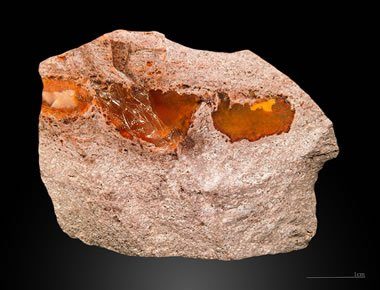
Many gem deposits are hosted in rhyolite. These occur for a logical reason. The thick granitic lava that forms rhyolite often cools quickly while pockets of gas are still trapped inside of the lava. As the lava quickly cools, the trapped gas is unable to escape and forms cavities known as “vugs.” Later, when the lava flow has cooled and hydrothermal gases or ground water move through, material can precipitate in the vugs. This is how some of the world’s best deposits of red beryl, topaz, agate, jasper, and opal are formed. Gem hunters have learned this and are always on the lookout for vuggy rhyolite.