People have been producing solar salt from ocean water for thousands of years. Solar salt can be produced in parts of the world where evaporation rates significantly exceed precipitation rates. The name “solar” means that the sun acts as a heat source to evaporate ocean water (or brine brought up from the subsurface), leaving behind its dissolved salt.

Historically, the salt was produced in shallow ponds, built along the seashore with inlets just below the level of high tide. Then, twice each day, at the instant that high tide reaches its peak, water flows into the ponds to fill them with salt-laden water. Then for the next 12 hours, the water evaporates to produce salt. This process has been operated as an industry for thousands of years.
How much salt can be made? That depends upon the climate, the weather, the surface area of the ponds, how they are built – and the knowledge of the people who tend them. For each liter of water they evaporate, about 35 grams of salt (about six teaspoons) can potentially be recovered.
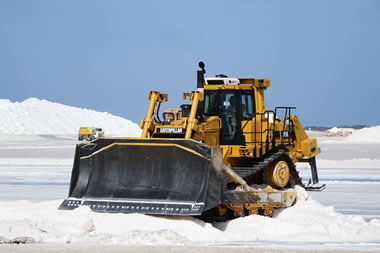
In the United States a few million tons of solar salt is produced each year. Arizona, California, Nevada, New Mexico, Oklahoma, and Utah are important solar salt producers. Brazil, Mexico, and India produce more solar salt than the United States.