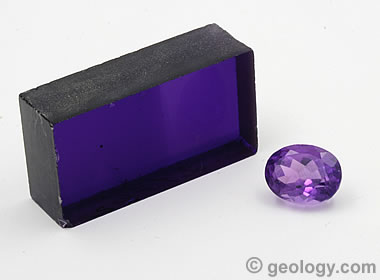
Even though amethyst is not an extremely costly material, synthetic amethyst has been manufactured at least as far back as 1970. Since then an enormous number of items have been produced from synthetic amethyst by faceting, cabbing and carving. These have entered all levels of the jewelry trade. This has disappointed many jewelry consumers and made them hesitant to purchase amethyst.
Experienced gemologists can identify some natural amethyst with a microscope if it exhibits color zoning and contains characteristic mineral inclusions. However, much of the natural amethyst is of a very high clarity grade, and finding identifying inclusions can be difficult or impossible.
In the early days of synthetic amethyst, most synthetic material did not exhibit Brazil law twinning, which is almost always present in natural amethyst. This could be used to identify some synthetic material, but when synthetic amethyst manufacturers learned of this, they began using twinned amethyst slices as seed crystals. Now almost all synthetic amethyst is coming out of the lab with Brazil law twinning.