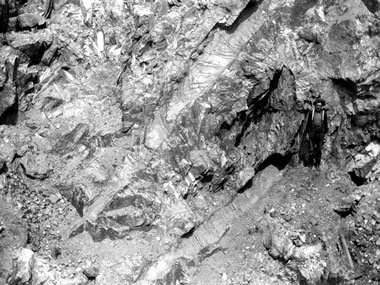
Large crystals in igneous rocks are usually attributed to a slow rate of crystallization. However, with pegmatites, large crystals are attributed to low-viscosity fluids that allow ions to be very mobile.
During the early states of a magma’s crystallization, the melt usually contains a significant amount of dissolved water and other volatiles such as chlorine, fluorine, and carbon dioxide. Water is not removed from the melt during the early crystallization process, so its concentration in the melt grows as crystallization progresses. Eventually there is an overabundance of water, and pockets of water separate from the melt.
These pockets of superheated water are extremely rich in dissolved ions. The ions in the water are much more mobile than ions in the melt. This allows them to move about freely and form crystals rapidly. This is why crystals of a pegmatite grow so large.
The extreme conditions of crystallization sometimes produce crystals that are several meters in length and weigh over one ton. For example: a large crystal of spodumene at the Etta Mine in South Dakota was 42 feet long, 5 feet in diameter and yielded 90 tons of spodumene!