In 1878 one of the largest yellow diamonds ever found was unearthed at the Kimberley Mine in the North Cape Province of South Africa. The rough diamond weighed 287.42 carats and it was purchased by Charles Tiffany, the New York jeweler who founded the world-famous firm of Tiffany and Company in 1837.
Tiffany’s gemologist, George Frederick Kunz, who was only 23 years old at the time, determined that a cushion-cut design would best utilize the rough. However, if he cut the diamond into a cushion cut of standard proportions, the potential of such a large stone would not be realized. So, he designed a special cut that added facets to the crown of the stone to increase its scintillation, and added facets to the pavilion to increase the amount of light returned to the eye of the viewer. The result was a yellow diamond of much higher brilliance. In all, 24 extra facets were added, and the design became known as the modified antique cushion brilliant cut. The finished stone weighed 128.54 carats.
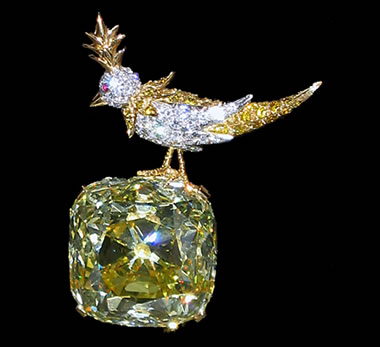
The Famous Tiffany Yellow in its “Bird on a Rock” setting, designed by Jean Schlumberger and first displayed in 1995. Today the Tiffany Yellow is the focal stone of a pendant, on a setting that is adorned with 78 “white” diamonds with a total weight of over 100 carats.