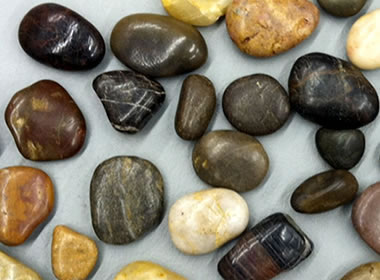
Many manufacturers treat tumbled stones with heat, dye, oil, or wax. These treatments can improve the appearance and marketability of the stones. Heat and dye can change the color of a stone. Oil and wax can conceal fractures, hide a bad polishing job, or make a smooth rough stone look like it has been polished.
Dye Treatment:
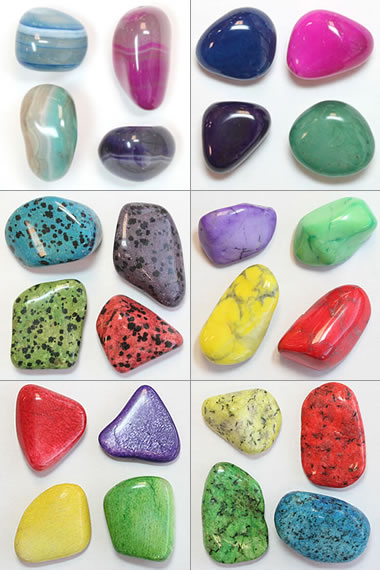
Dying is possible because many tumbled stone materials are porous. This allows colored dye solutions to enter the stone and impart a bright color. Brightly colored stones are often easier to sell and many people like them. Dye is usually used on light-colored, inexpensive, noncommercial stones that can be tumbled in a short amount of time. These include: magnesite, diorite, granite, feldspar, and agate.
Dyed stones are often not colorfast. Some will lose their color with prolonged exposure to sunlight. Water-soluble dyes can transfer from a stone into water or onto hands, clothes, or other objects. Dyed stones usually fade if they are placed outdoors in exposed locations. Vendors who sell dyed stones should inform buyers to prevent disappointment.
Heat Treatment:
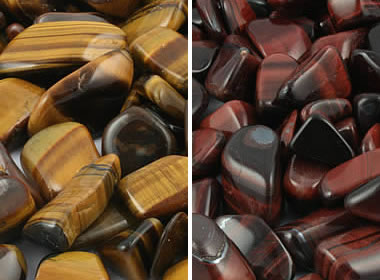
Many materials will change color upon heating. Gold tiger’s-eye can turn red with heating. Amethyst can turn yellow, orange, gold, brown, or green with heating. These stones are then often sold as “citrine” or “prasiolite.” Vendors who sell these stones should disclose the treatment because the “commercial identity” has changed.
Some light-colored agates will turn brown or orange with heating, or black if they are first soaked in a sugar solution. These are sometimes sold as “carnelian,” “onyx,” or “black chalcedony.” These heat treatments are permanent, but buyers should be informed because the “commercial identity” of the stone has changed.
The heating process can also occur naturally. Agate, tiger’s-eye, and amethyst are materials that sometimes form in volcanic landscapes. They can be heated if the rock units that contain them are overrun by a lava flow or if a magma body intrudes above or below. The altered identity of these stones is considered to be “natural.”
Oil and Wax Treatments:
Some tumbled stones are waxed or oiled to give them a shiny appearance. Wax and oil can fill fractures or surface irregularities and give the stones a brighter luster. Wax or oil are sometimes applied to common river or beach stones to make them look like they have been polished. Waxes and oils usually wear off over time with handling or exposure to water, soap, or sunlight. These treatments are not permanent and should be disclosed by the vendor.
The word “polished” can be used in multiple ways. One definition would be: “something has been done to make the surface of a stone smooth and shiny.” Another definition would be: “something has been done to make the surface of a stone look smooth and shiny.” Both of these would likely satisfy a dictionary definition of the word “polished.” But there is a subtle difference that would be significant in the minds of some people. In jewelry and lapidary terms, only the first definition is a “genuine polish.” The surface of the stone has been worked with sufficient care and skill to give it a smooth and shiny surface. A person who works hard to “polish” stones this way might strongly object to seeing oiled or waxed stones marketed as “polished stones.” However, these oiled and waxed stones might meet the dictionary definition of the word “polished.”