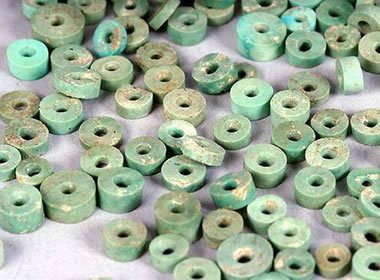
The earliest record of turquoise being used in jewelry or in ornaments is from Egypt. There, turquoise has been found in royal burials over 6000 years old. About 4000 years ago, miners in Persia produced a blue variety of turquoise with a “sky blue” or “robin’s-egg blue” color. This material was very popular and traded through Asia and into Europe. This is the source of the term “Persian Blue” color.
In North America the earliest known use of turquoise was in the Chaco Canyon area of New Mexico, where the gem was used over 2000 years ago. Ancient artists produced beads, pendants, inlay work, and small sculptures.
Rough turquoise and turquoise objects were held in high regard by Native Americans and were traded widely. This spread North American turquoise across the southwest and into South America. These early Native American jewelry designs were simple, and the turquoise was not set in metal findings.
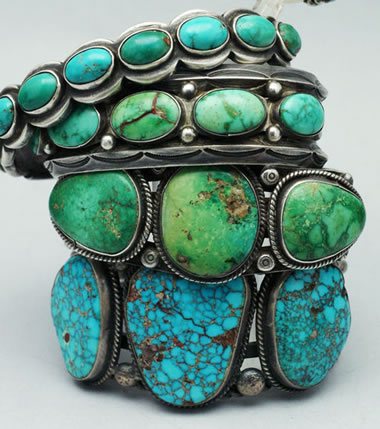
In the late 1800s, Native American artists began using coin silver to make jewelry. This work evolved into the turquoise and sterling silver style of Native American jewelry that is popular today.
The demand for turquoise and turquoise jewelry rises and falls over time. In 1912, turquoise was named as one of the original modern birthstones for the month of December. This gave the gem a small boost in popularity which continues to the present.
In the United States there was a surge in turquoise demand that began in the 1970s and declined in the 1980s. Demand for turquoise jewelry is always highest in the southwestern states where turquoise mining and Native American artists make turquoise a distinctive part of the local culture.