Companies interested in developing a salt resource located hundreds to thousands of feet below the surface usually drill numerous wells down to and through the salt layer. They drill to learn the thickness of the salt and what types of rocks enclose it.
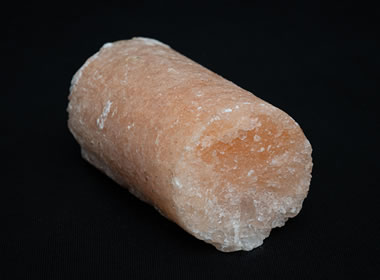
They also obtain core samples of the salt (see accompanying photo) that will be used to determine its chemical and mineral composition. The purity of the salt determines how it can be used. The depth determines the cost to build the mine. Depth also determines the electricity costs of operation, ventilation, and lifting salt, equipment, people, and water in and out of the mine.
Most of the rock salt produced in the United States is produced by traditional room and pillar mining – a mining method that is widely employed in mining for coal. This involves sending people and machines underground to remove the salt. The salt is usually hundreds of feet below Earth’s surface.
To start the mine, a large-diameter shaft is drilled vertically down to the salt layer. That shaft will be equipped with lifts, much like elevators, that will be used to lower equipment, people, and supplies down to the level of the salt. Other shafts will be built down to the salt. Some of these shafts will be used to lift the mined salt up to the surface. Others will be used to bring fresh air into the mine or exhaust mine air to the surface.
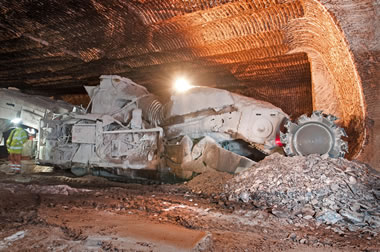
Once they have been lowered down a shaft to the level of the salt, the mining machines will begin cutting underground tunnels through the salt. A large cylindrical drum with cutting picks is mounted on the front of the mining machine. This drum rotates and cuts its way through the salt (see accompanying photo).
As a mining machine cuts its way through the salt, broken pieces of salt fall onto a large metal pan mounted immediately below the rotating cutting drum. Mechanized arms rake the salt up the pan and onto a conveyor that carries the salt to a waiting wagon or to a mobile conveyor system. The conveyor will transport the salt to a mine shaft, where the salt will be lifted to the surface, or to an underground storage area. This is the basic process of underground salt mining with a continuous mining machine.