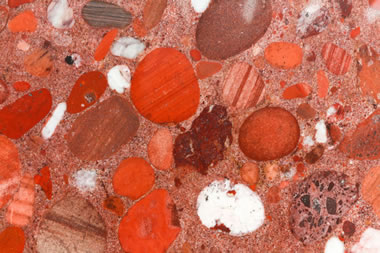
Conglomerate has very few commercial uses. Its inability to break cleanly makes it a poor candidate for dimension stone, and its variable composition makes it a rock of unreliable physical strength and durability.
Conglomerate can be crushed to make a fine aggregate that can be used where a low-performance material is suitable. Many conglomerates are colorful and attractive rocks, but they are rarely used as an ornamental stone.
Analysis of conglomerate can sometimes be used as a prospecting tool. For example, most diamond deposits are hosted in kimberlite. If a conglomerate contains clasts of kimberlite, then the source of that kimberlite must be upstream of the location where the kimberlite clast was deposited. That sounds simple, but the kimberlite clast might have been deposited a few million years ago in a different landscape – but people have been successful in using this type of clue to successfully locate a diamond deposit.
In rare instances, conglomerate can be a “fossil placer deposit” containing gold, diamonds, or other valuable minerals. These conglomerates are mined, crushed, and processed as ores.