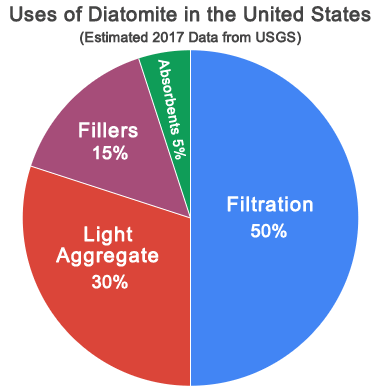
The four main uses of diatomite in the United States during 2017 were filtration (50%), light aggregate (30%), fillers (15%), and absorbents (5%). The properties of diatomite that make it useful in these applications are listed below.
 Small particle sizeHigh porosityHigh surface areaRelatively inert siliceous compositionLow specific gravity Small particle sizeHigh porosityHigh surface areaRelatively inert siliceous compositionLow specific gravity |
Filter Media
The small particle size of diatomaceous earth and the open structure of the frustules enable it to work effectively as a particle filter. The pores within and between the frustule are small enough to trap bacteria, clay particles, and other suspended solids. It is used at drinking water treatment plants, swimming pools, breweries, wineries, chemical plants, and where juices and syrups are made. These fluids are forced through a layer of wet diatomaceous earth, and suspended particles are trapped because they cannot fit through the pores.
Cement Additive
Diatomite is often used as an additive in the manufacture of portland cement. High-quality diatomite contains over 80% silica, and it is added to the cement-making process to boost the silica content of the product. Diatomite straight from the mine is crushed and blended with the limestone, shale, or other materials being used to make the cement.
Filler
Diatomaceous earth is used as a lightweight, inert filler in some manufactured products. It is added to paint as a whitening agent and extender. It is added to plastics as a lightweight filler. It is used as a filler and anti-stick agent in asphalt shingles. It is used as a filler and to improve adhesion resistance in many rubber products.
Absorbent
If dry diatomaceous earth is placed on a liquid spill, it can absorb and hold an amount of liquid equivalent to its own weight. This absorption facilitates containment, cleanup, and removal. Capillary action of liquids into diatomaceous earth is enhanced by its small particle size, high surface area, and its high porosity.
These same properties make diatomaceous earth able to absorb skin oils when used in cosmetics and facial masks. Diatomaceous earth is an absorbent ingredient of some kitty litters. It is also used as a soil treatment to absorb and hold water.
Mild Abrasive
Diatomaceous earth is used as a mild abrasive in some toothpastes, facial scrubs, and metal polishes. Its silica particles are small, friable, have a high surface area, and are angular in shape. These are properties that help it perform well as a mild abrasive.
Gardening
Diatomaceous earth is used as a growing medium in hydroponic gardens. It is inert, holds water, and has a porosity that allows the soil to breathe. To help grain and other seeds from sticking together and remain dry, they are dusted with diatomaceous earth.
Insect and Slug Control
Diatomaceous earth is an abrasive and an absorbent. These properties make it effective in controlling slugs and certain insects. To control ants, fleas, roaches, lice, mites, and ticks indoors, vacuum the infested area, then dust it with a small amount of diatomaceous earth. Repeat every few weeks until resolved.
Slugs can be deterred outdoors by dusting problem areas with diatomaceous earth. If slugs are disturbing plants, dust the soil around the base of the plant. Diatomaceous earth works only when dry. The best time to apply it is when slugs are present and rain is not expected for at least 24 hours.
Flea and Tick Control
Dogs and cats can be treated with food-grade diatomaceous earth to control fleas and ticks. Before treating the pet, clean their bedding materials, and vacuum rugs where the pet is allowed to roam. Then lightly dust these areas with diatomaceous earth. Repeat every few days.
To treat the pet, brush, comb, and inspect the animal to remove fleas and ticks. Then dust the pet lightly with diatomaceous earth. Bathe the pet after two or three days with a moisturizing shampoo. After the bath, brush or comb the pet to remove any fleas or ticks that remain. Repeat dusting and combing every few days. Bathe the pet about once a month with moisturizing shampoo.