Granite is the rock most often quarried as a “dimension stone” (a natural rock material that will be cut into blocks or slabs of specific length, width, and thickness). Granite is hard enough to resist abrasion, strong enough to bear significant weight, inert enough to resist weathering, and it accepts a brilliant polish. These characteristics make it a very desirable and useful dimension stone.
Most of the granite dimension stone produced in the United States comes from high-quality deposits in five states: Massachusetts, Georgia, New Hampshire, South Dakota, and Idaho.
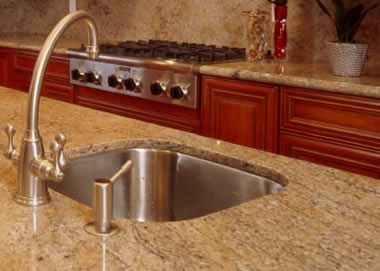
Granite has been used for thousands of years in both interior and exterior applications. Rough-cut and polished granite is used in buildings, bridges, paving, monuments, and many other exterior projects. Indoors, polished granite slabs and tiles are used as countertops, floor tiles, stair treads, and many other practical and decorative features.
High price often reduces the popularity of a construction material. Granite often costs significantly more than man-made materials. However, granite is frequently selected because it is a prestige material, used in projects to produce impressions of elegance, durability, and lasting quality.

Granite is also used as a crushed stone or aggregate. In this form it is used as a base material at construction sites, as an aggregate in road construction, railroad ballast, foundations, and anywhere that a crushed stone is useful as fill.