Quartzite has a diversity of uses in construction, manufacturing, architecture, and decorative arts. Although its properties are superior to many currently used materials, its consumption has always been low for various reasons. The uses of quartzite and some reasons that it is avoided are summarized below.
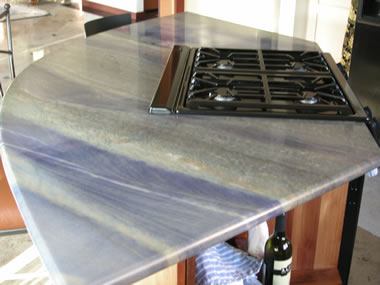
Architectural Use
In architecture, marble and granite have been the favorite materials for thousands of years. Quartzite, with a Mohs hardness of seven along with greater toughness, is superior to both in many uses.
It stands up better to abrasion in stair treads, floor tiles, and countertops. It is more resistant to most chemicals and environmental conditions. It is available in a range of neutral colors that many people enjoy. The use of quartzite in these uses is growing slowly as more people learn about it.
There are also man-made materials marketed under the name quartzite. They can be attractive and durable with a cost comparable to natural materials. Read the marketing materials prepared by the manufacturer.
Construction Use
Quartzite can be an extremely durable crushed stone that is suitable for use in the most demanding applications. Its soundness and abrasion resistance are superior to most other materials.
Unfortunately, the same durability that makes quartzite a superior construction material also limits its use. Its hardness and toughness cause heavy wear on crushers, screens, truck beds, cutting tools, loaders, tires, tracks, drill bits, and other equipment. As a result, the use of quartzite is mainly limited to geographic areas where other aggregates are not available.
Manufacturing Use
Quartzite is valued as a raw material because of its high silica content. A few unusual deposits have a silica content of over 98%. These are mined and used to manufacture glass, ferrosilicon, manganese ferrosilicon, silicon metal, silicon carbide, and other materials.
Decorative and Gemological Use
Quartzite can be a very attractive stone when it is colored by inclusions. Inclusions of fuchsite (a green chromium-rich variety of muscovite mica) can give quartzite a pleasing green color. If the quartzite is semitransparent to translucent, the flat flakes of mica can reflect light to produce a glittering luster known as aventurescence.
Material that displays this property is known as “aventurine,” a popular material used to produce beads, cabochons, tumbled stones, and small ornaments. Aventurine can be pink or red when stained with iron. Included dumortierite produces a blue color. Other inclusions produce white, gray, orange, or yellow aventurine.
Stone Tools
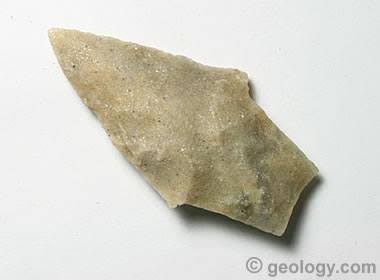
Quartzite has been used by humans to make stone tools for over one million years. It was mainly used for impact tools, but its conchoidal fracture allowed it to be broken to form sharp edges. Broken pieces of quartzite were used for crude cutting and chopping tools.
Quartzite was not the preferred material for producing cutting tools such as knife blades and projectile points – but it has been used. Flint, chert, jasper, agate, and obsidian all can be knapped to produce fine cutting edges, which are difficult to produce when working quartzite. Quartzite was most frequently used when it was locally abundant and superior materials were rare or not available.