Some shales have special properties that make them important resources. Black shales contain organic material that sometimes breaks down to form natural gas or oil. Other shales can be crushed and mixed with water to produce clays that can be made into a variety of useful objects.
Conventional Oil and Natural Gas
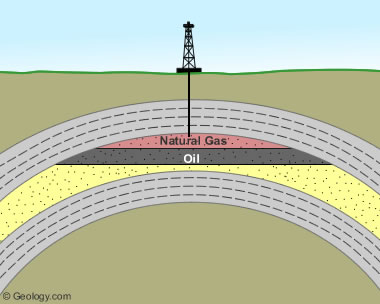
Black organic shales are the source rock for many of the world’s most important oil and natural gas deposits. These shales obtain their black color from tiny particles of organic matter that were deposited with the mud from which the shale formed. As the mud was buried and warmed within the earth, some of the organic material was transformed into oil and natural gas.
The oil and natural gas migrated out of the shale and upwards through the sediment mass because of their low density. The oil and gas were often trapped within the pore spaces of an overlying rock unit such as a sandstone (see illustration). These types of oil and gas deposits are known as “conventional reservoirs” because the fluids can easily flow through the pores of the rock and into the extraction well.
Although drilling can extract large amounts of oil and natural gas from the reservoir rock, much of it remains trapped within the shale. This oil and gas is very difficult to remove because it is trapped within tiny pore spaces or adsorbed onto clay mineral particles that make up the shale.
Unconventional Oil and Natural Gas
In the late 1990s, natural gas drilling companies developed new methods for liberating oil and natural gas that is trapped within the tiny pore spaces of shale. This discovery was significant because it unlocked some of the largest natural gas deposits in the world.
The Barnett Shale of Texas was the first major natural gas field developed in a shale reservoir rock. Producing gas from the Barnett Shale was a challenge. The pore spaces in shale are so tiny that the gas has difficulty moving through the shale and into the well. Drillers discovered that they could increase the permeability of the shale by pumping water down the well under pressure that was high enough to fracture the shale. These fractures liberated some of the gas from the pore spaces and allowed that gas to flow to the well. This technique is known as “hydraulic fracturing” or “hydrofracing.”
Drillers also learned how to drill down to the level of the shale and turn the well 90 degrees to drill horizontally through the shale rock unit. This produced a well with a very long “pay zone” through the reservoir rock (see illustration). This method is known as “horizontal drilling.”
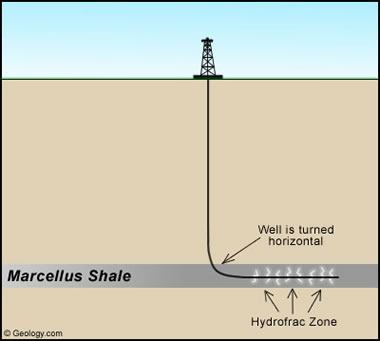
Horizontal drilling and hydraulic fracturing revolutionized drilling technology and paved the way for developing several giant natural gas fields. These include the Marcellus Shale in the Appalachians, the Haynesville Shale in Louisiana, and the Fayetteville Shale in Arkansas. These enormous shale reservoirs hold enough natural gas to serve all of the United States’ needs for twenty years or more.