The three varieties of gem-grade chrysoberyl and their cutting styles:
- chrysoberyl: translucent to transparent, without phenomena, faceted;
- cat’s-eye: a chatoyant gem cut en cabochon; and
- alexandrite: a color-change gem, cut en cabochon or faceted.
1) Chrysoberyl
Translucent to transparent crystals of chrysoberyl are usually found in pegmatites, dolomitic marbles, and stream sediments. They are often yellow, yellowish green, green, brown or yellowish brown, and weigh less than five carats. Rare blue chrysoberyl crystals have also been found.
Most chrysoberyl crystals are nonphenomenal (that is, they do not exhibit chatoyance or color-change). Gemologists simply call them “chrysoberyl”. Natural nonphenomenal chrysoberyl is rare, moderately expensive, seldom seen in jewelry stores, and most jewelry shoppers have never heard of it. If you are interested in chrysoberyl jewelry, you might find it at a store owned by a jewelry designer who specializes in rare and seldom-seen gems.
Be cautious when buying chrysoberyl. Much of the chrysoberyl jewelry being sold online is made with synthetic chrysoberyl or imitation chrysoberyl. These should be priced significantly less than similar jewelry made with natural chrysoberyl. If you are paying major money for a piece or you only want to purchase natural gems, be careful in your transactions. See our section below about synthetic and imitation chrysoberyl.
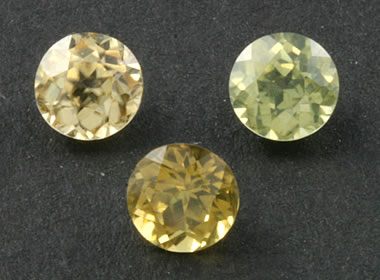
Chrysoberyl: Three faceted chrysoberyls showing a range of yellow and yellow-green color. These stones were produced in Sri Lanka and are about 4.3 millimeters in diameter and weigh about 0.52 carats each – a very high weight for stones of this size, caused by chrysoberyl’s high specific gravity.
2) Cat’s-Eye
Chrysoberyl is the gemstone that produces the most distinct “cat’s-eye,” or chatoyance. If a person uses the name “cat’s-eye” without the name of another gemstone (for example, “cat’s-eye tourmaline”), then they are most likely referring to chatoyant chrysoberyl. Cat’s-eye chrysoberyl has also been called “cymophane.”
The phenomenon of cat’s-eye occurs in cabochon-cut stones that contain a high density of parallel fibrous inclusions. The “cat’s-eye” is a line of light that reflects from the dome of the cabochon at right angles to the parallel inclusions. The line of light is very similar to how a spool of silk thread will produce a line of reflection across the top of the spool as it is moved back and forth under a source of light.
Some specimens of cat’s-eye will appear to have a different color on each side of the cat’s-eye line when illuminated from the proper direction with respect to the observer’s eye. It gives the illusion that the stone is made of two different materials, a light material on one side of the line and a dark material on the other. This phenomenon is known as the “milk-and-honey” effect.
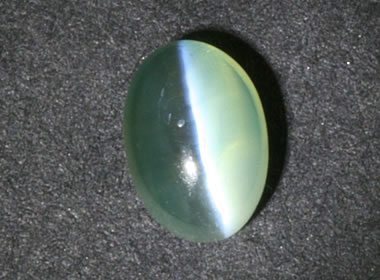
Cat’s-Eye Chrysoberyl: Chrysoberyl that contains large numbers of fibrous inclusions can produce a “cat’s-eye,” a line of light across the surface of the stone that orients perpendicular to the included fibers. Chrysoberyl is the gem that exhibits the finest cat’s-eyes, and when the term “cat’s-eye” is used without a mineral name as a modifier, the speaker is most likely referring to chrysoberyl. This specimen exhibits the “milk-and-honey” effect – when properly oriented, the stone has two apparently different colors on each side of the cat’s-eye line. This green cat’s-eye chrysoberyl was produced in Sri Lanka and is about 5.6 x 4 millimeters in size.
3) Alexandrite
Alexandrite is the color-change variety of chrysoberyl. The most distinctive specimens appear to have a green to blue-green color in daylight but change to a red to purplish-red color under incandescent light. Specimens with strong and distinct color-change properties are rare, highly desirable, and sell at very high prices. Stones over five carats are especially rare. A photo pair of an alexandrite gem in daylight and incandescent light is shown on this page.
The change in color is thought to occur only in specimens where chromium substitutes for aluminum in the mineral’s atomic structure. The chrysoberyl in which this phenomenon was first observed was named “alexandrite” after Tsar Alexander II of Russia. Since then the “alexandrite effect” has been observed in other gems, which include color-change garnet, spinel, tourmaline, sapphire, and fluorite.
Alexandrite is a rare material, only found in very small deposits. It was first discovered in the Ural Mountains of Russia in the late 1800s. Although that deposit has been mined out, small deposits have since been discovered in Brazil, India, Sri Lanka, Myanmar, China, Zimbabwe, Tanzania, Madagascar, Tasmania, and the United States.
Alexandrite can also be strongly pleochroic (a stone that has a different apparent hue when viewed from different directions). It is a trichroic stone (exhibiting three different hues from three different directions) with a green, red, or yellow-orange hue depending upon the direction of observation. The pleochroism of chrysoberyl is not apparent in all specimens and varies under different types of light. It is not as distinctive as the color-change effect.
Alexandrite serves as a birthstone for the month of June. It joined pearl as a June birthstone in 1952, when the list of modern birthstones was revised. Alexandrite gave people born in June the option of a durable faceted stone. Although natural alexandrite is extremely expensive, lab-grown alexandrite is inexpensive and widely available.