The most widely known and sought-after geodes are those that formed in areas of volcanic activity. Voids in basaltic lava flows often are infilled with agate, quartz, opal and other material delivered by hydrothermal water or groundwater. Some voids are spaces occupied by gases that failed to escape the lava flow before its surface crusted over.
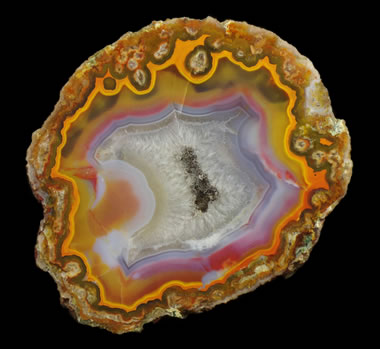
Where does all of the gas come from? Some magmas contain a lot of dissolved gas. They can be several percent dissolved gas on the basis of weight. (Think about that – several percent gas by weight!) When these magmas ascend to the surface, the gas expands in proportion to the pressure reduction. When the magma erupts as a lava flow, so much gas is released that not all of it is able to escape. Some of that gas can be trapped in the lava to produce a large cavity when the lava solidifies.
Other voids in solidified lava flows were produced as liquid lava flowed out after the flow was only partially solidified. These small “lava tubes” produce some of the largest and longest geodes. Many cathedral geodes are branches of these lava tubes that later infilled with mineral material. Many of them have the geometry of long tree branches, being nearly a meter in diameter and many meters in length.