A mineraloid is a naturally occurring, inorganic solid that does not exhibit crystallinity. It may have the outward appearance of a mineral, but it does not have the “ordered atomic structure” required to meet the definition of a mineral. Some mineraloids also lack the “definite chemical composition” required to be a mineral.
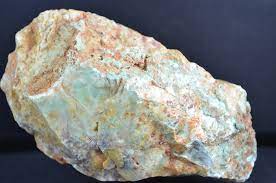
To be considered a mineral, a material must meet the following five requirements:
1). Naturally Occuring
2). Inorganic
3). Solid
4). Ordered Atomic Structure
5). Definite chemical composition
Minerals are “crystalline.” In other words, they have an ordered atomic structure. In contrast, mineraloids are “amorphous.” This means that their internal atomic structure is not ordered.
Without the ordered atomic structure, mineraloids never produce well-formed crystals. They also do not exhibit the property of cleavage because they lack internal planes of weakness.