The colors of amethyst and citrine are produced by iron impurities with different oxidation states within the quartz. Purple is thought to be produced by Fe3+ that is oxidized to Fe4+ by natural radiation emitted by the decay of potassium-40 in nearby rocks. The golden-yellow is thought to be produced by Fe3+.
If a well-formed ametrine crystal is sawn perpendicular to the c-axis, the color zones of amethyst and citrine often form a geometric pattern that radiates outwards from the c-axis like the pieces of a pie. Straight-line contacts separate zones of amethyst from zones of citrine. This pattern is formed by Brazil law twinning in which two quartz crystals of different color are intergrown to form the bicolor gemstone. It is very different from the bicolor zones of a tourmaline crystal which form by sequential crystallization.
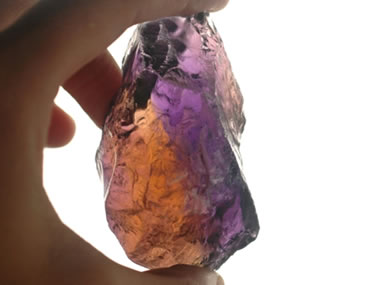
Ametrine rough: A large piece of very high quality ametrine rough with beautiful richly colored amethyst and citrine in sharp contact with one another. A piece of rough like this could be used to cut stones or carvings.