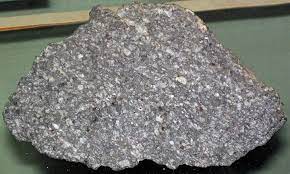
Rhyolite is an extrusive igneous rock with a very high silica content. It is usually pink or gray in color with grains so small that they are difficult to observe without a hand lens. Rhyolite is made up of quartz, plagioclase, and sanidine, with minor amounts of hornblende and biotite. Trapped gases often produce vugs in the rock. These often contain crystals, opal, or glassy material.
Many rhyolites form from granitic magma that has partially cooled in the subsurface. When these magmas erupt, a rock with two grain sizes can form. The large crystals that formed beneath the surface are called phenocrysts, and the small crystals formed at the surface are called groundmass.
Rhyolite usually forms in continental or continent-margin volcanic eruptions where granitic magma reaches the surface. Rhyolite is rarely produced at oceanic eruptions.