Serpentine is not the name of a single mineral. Instead it is a name used for a large group of minerals that fit this generalized formula:
(X)2-3(Y)2O5(OH)4.
In this formula, X will be one of the following metals: magnesium, iron, nickel, aluminum, zinc, or manganese; and, Y will be silicon, aluminum, or iron. The appropriate generalized formula is therefore as follows:
(Mg,Fe,Ni, Mn,Zn)2-3(Si,Al,Fe)2O5(OH)4.
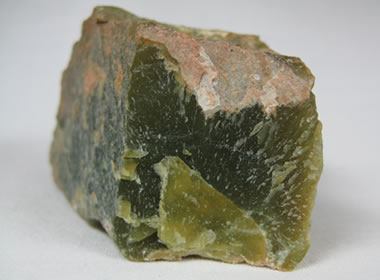
Chrysotile, antigorite, and lizardite are three of the primary serpentine minerals. There are many other serpentine minerals, most of which are rare.
Serpentine group minerals have similar physical properties and form by similar processes. They often occur as fine-grained admixtures and can be difficult to distinguish within a rock. Geologists usually call these materials “serpentine” rather than more specific names to simplify communication.