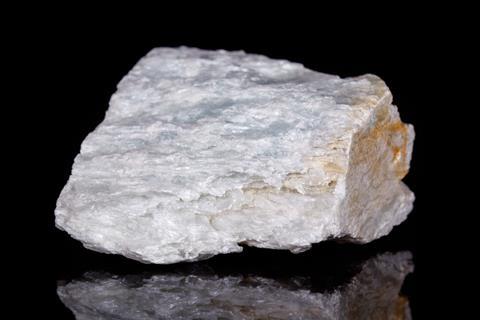
Talc is a hydrous magnesium silicate mineral with a chemical composition of Mg3Si4O10(OH)2. Although the composition of talc usually stays close to this generalized formula, some substitution occurs. Small amounts of Al or Ti can substitute for Si; small amounts of Fe, Mn, and Al can substitute for Mg; and, very small amounts of Ca can substitute for Mg.
When large amounts of Fe substitute for Mg, the mineral is known as minnesotaite. When large amounts of Al substitute for Mg, the mineral is known as pyrophyllite.
Talc is usually green, white, gray, brown, or colorless. It is a translucent mineral with a pearly luster. It is the softest known mineral and is assigned a hardness of 1 on the Mohs Hardness Scale.
Talc is a monoclinic mineral with a sheet structure similar to the micas. Talc has perfect cleavage that follows planes between the weakly bonded sheets. These sheets are held together only by van der Waals bonds, which allows them to slip past one another easily. This characteristic is responsible for talc’s extreme softness, its greasy, soapy feel, and its value as a high-temperature lubricant.