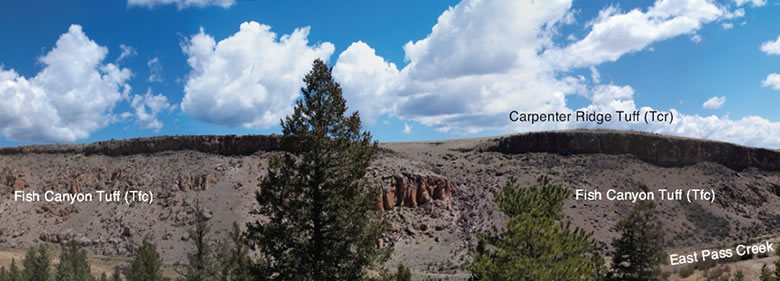
Tuff is an igneous rock that forms from the products of an explosive volcanic eruption. In these eruptions, the volcano blasts rock, ash, magma and other materials from its vent. This ejecta travels through the air and falls back to Earth in the area surrounding the volcano. If the ejected material is compacted and cemented into a rock, that rock will be called “tuff.”
Tuff is usually thickest near the volcanic vent and decreases in thickness with distance from the volcano. Instead of being a “layer,” a tuff is usually a “lens-shaped” deposit. Tuff can also be thickest on the downwind side of the vent or on the side of the vent where the blast was directed.
Some tuff deposits are hundreds of meters thick and have a total eruptive volume of many cubic miles. That enormous thickness can be from a single eruptive blast or, more commonly, from successive surges of a single eruption – or eruptions that were separated by long periods of time.