So, the name “granite” is a name used for igneous rocks that are composed of orthoclase feldspar, quartz, plagioclase feldspar, micas, and amphiboles that are present in crystals large enough to be visible with the unaided eye.
That name isn’t specific enough for some purposes and for some people.
Special names are used for granitic rocks based upon their grain (crystal) size. If a granitic rock has especially large grains (over one centimeter across), it is often called “pegmatite.” If it is an especially fine-grained rock from crystallizing at a shallow depth, it might be called “aplite.”
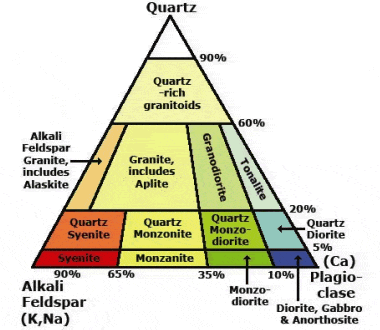
Granitic rocks that have a mineral composition that borders upon diorite might be called “granodiorite.” Those especially rich in plagioclase feldspars, at the expense of alkali feldspars, might be called “monzodiorites.”
The accompanying triangular diagram displays a classification method used for granitic rocks based upon the relative abundances of quartz, alkali feldspars, and plagioclase feldspars. This is not a chart for use by the beginning student of igneous rocks. It is a classification used by experts who have the skills and equipment needed to quantify the mineral composition of the rock.