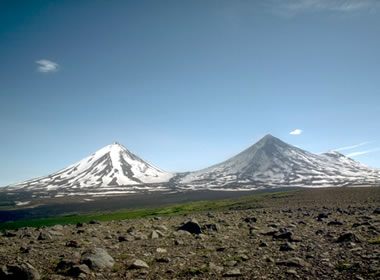
Andesite and diorite are common rocks of the continental crust above subduction zones. They generally form after an oceanic plate melts during its descent into the subduction zone to produce a source of magma.
Diorite is a coarse-grained igneous rock that forms when the magma remains below Earth’s surface and cools slowly. Slow cooling facilitates the growth of large mineral crystals in the rock. Andesite is a fine-grained rock that forms when the magma erupts onto the surface and crystallizes quickly.
Andesite and diorite have a composition that is intermediate between basalt and granite. This is because their parent magmas formed from the partial melting of a basaltic oceanic plate. This magma may have received a granitic contribution by melting granitic rocks as it ascended or mixed with granitic magma.