Malachite is a mineral that forms at shallow depths within the Earth, in the oxidizing zone above copper deposits. It precipitates from descending solutions in fractures, caverns, cavities, and the intergranular spaces of porous rock. It often forms within limestone where a subsurface chemical environment favorable for the formation of carbonate minerals can occur. Associated minerals include azurite, bornite, calcite, chalcopyrite, copper, cuprite, and a variety of iron oxides.
Some of the first malachite deposits to be exploited were located in Egypt and Israel. Over 4000 years ago, they were mined and used to produce copper. Material from these deposits was also used to produce gemstones, sculptures, and pigments. Several large deposits in the Ural Mountains of Russia were aggressively mined, and they supplied abundant gem and sculptural material in the 1800s. Very little is produced from these deposits today. Much of the malachite entering the lapidary market today is from deposits in the Democratic Republic of the Congo. Smaller amounts are produced in Australia, France, and Arizona.
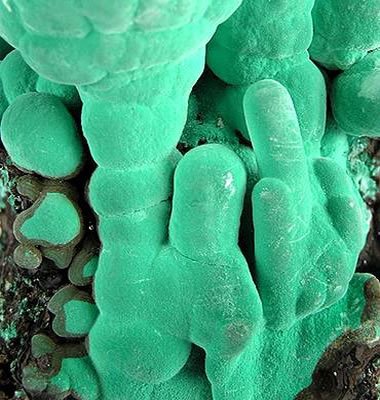
Botryoidal Malachite: Close-up of botryoidal malachite in a seafoam green color from Bisbee, Arizona. This view spans an area of the specimen about 5 millimeters wide and high.