Zircon has been used as a gemstone for over 2000 years. Its very high dispersion and refractive index give it a brilliance and fire that rival those of diamond. For that reason, colorless faceted zircon has been used as both a popular and fraudulent substitute for diamond.
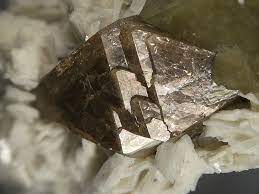
Gemologists and many knowledgeable jewelers are able to distinguish zircon from diamond with a quick examination. To do this they look into the stone, through the table facet, and focus on the pavilion facet junctions, with a 10x loupe. The pavilion facet junctions should appear as double-images caused by zircon’s double-refraction. Diamond is singly refractive and will not show doubling of features within the stone. This same test can be used to distinguish zircon from cubic zirconia.
Zircon is a popular gem because it is available in a variety of pleasing colors. Most natural zircons are yellow, red, or brown. Heating and irradiation can be used to produce colorless, blue, green, and many other zircon colors. Blue is the most popular zircon color. About 80% of the zircons sold today are blue.
Although it is not as durable as diamond, zircon has good physical durability as a gem. It has a hardness of 6 to 7.5 and imperfect cleavage. That combination makes it suitable for most gemstone uses that include rings, earrings, pendants, brooches and other jewelry. Some zircon, especially gems that have been heat treated, can be brittle. The facet edges of these gems are susceptible to nicks and chipping.
| Physical Properties of Zircon | |
| Chemical Classification | Silicate |
| Color | Usually yellow, brown, or red. Also colorless, gray, blue, and green. |
| Streak | Colorless. Usually harder than the streak plate. |
| Luster | Vitreous to adamantine, sometimes oily. |
| Diaphaneity | Translucent to transparent |
| Cleavage | Imperfect |
| Mohs Hardness | 6 to 7.5 |
| Specific Gravity | 4.6 to 4.7 |
| Diagnostic Properties | Hardness, luster, specific gravity |
| Chemical Composition | ZrSiO4 |
| Crystal System | Tetragonal |
| Uses | Ore of zirconium metal, ore of zirconium dioxide, whitening agents, white pigment, gemstones, radiometric dating. |