Zircon has been mined from stream gravels for over 2000 years. This early mining of zircon was mainly to obtain nice crystals for use as gemstones. Today, most zircon is produced by mining or dredging zircon-rich sediments. These sediments can be in beach, littoral, or alluvial deposits.
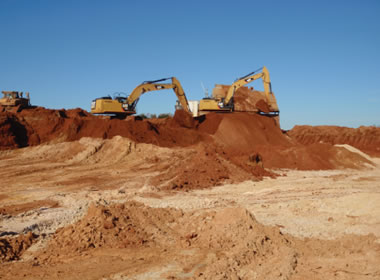
Zircon has a specific gravity of 4.6 to 4.7, which is much higher than the typical detrital sediment grain that is between 2.6 and 2.8. This specific gravity difference allows zircon grains to be recovered from the sediments by mechanical separation. Specific gravity separation methods make it possible to profitably recover zircon and other heavy minerals at an ore grade of just a few percent. Zircon is often a coproduct at mining/processing operations where ilmenite and rutile are being mined for titanium. In the United States, zircon is mined in Virginia, Georgia, North Carolina and Florida.
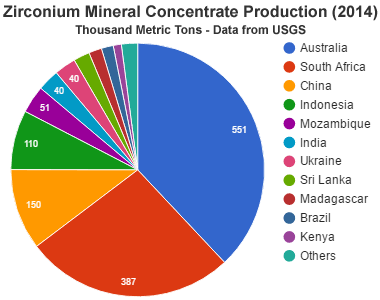
Industrial-grade zircon is mined from land- and marine-based deposits of alluvial origin in many parts of the world. Australia, South Africa, China, Indonesia, Mozambique, India, Ukraine, Sri Lanka, Madagascar, Brazil, Kenya and several other countries were important producers in 2014. These alluvial deposits contain mainly sub-millimeter grains of zircon derived from the weathering of granitic rocks.
Gem-grade zircon has been produced from alluvial deposits in Sri Lanka, Cambodia, Myanmar, and Vietnam for hundreds of years. More recent gem-grade deposits are in Australia, Nigeria, and Madagascar. Deposits mined for gem-grade zircon must contain crystals at least several millimeters in size with good clarity. They are typically derived from the weathering of carbonate rocks and other rock types associated with hydrothermal activity. Some of the best gem-grade zircon crystals are mined directly from cavities in pegmatite.